Adult Athleticism: Look, Move, and Feel Athletic—for Life
Total Fitness develops the multiplanar strength, power, movement skill, and work capacity adults need to remain capable as they age—through intelligent programming that challenges the body without adding unnecessary orthopedic cost.
No athletic background is required. The starting requirements are a willingness to show up, apply honest effort, and be coached.
What Is Adult Athleticism?
Adult athleticism is the ability to produce and absorb force, move with control in multiple directions, learn unfamiliar physical tasks, and maintain the strength, power, and work capacity required for a physically capable life.
It does not require competing in a sport. It means retaining access to your body.
An athletic adult can get off the floor, carry meaningful weight, move laterally, rotate, run, jump, throw, recover between efforts, and enter unfamiliar physical situations with confidence.
At The FIT Facility, the intended outcome is an adult who can look, move, and feel athletic—for life.
Look Athletic
Develop visible muscle and balanced physical proportions.
Improve body composition when nutrition supports the goal.
Carry the posture and physical presence of someone who trains with purpose.
Look capable without having to specialize in bodybuilding or competitive fitness.
Move Athletic
Produce, absorb, and redirect force.
Move through the sagittal, frontal, and transverse planes.
Learn new physical tasks with less explanation and correction.
Demonstrate strength from bilateral, unilateral, staggered, narrow, and offset positions.
Run, jump, throw, carry, rotate, and get off the floor with confidence.
Feel Athletic
Trust your body in physically demanding situations.
Experience more freedom and less self-imposed restriction.
Possess enough work capacity to remain useful after the first hard effort.
Participate with children, grandchildren, friends, and family instead of watching from the side.
Know that your body remains adaptable and trainable.
Physical Freedom Is the Real Outcome
When physical capacity declines, freedom declines with it.
The losses usually begin quietly. Getting off the floor becomes less convenient. Running feels foreign. Travel and recreation require more negotiation. Adults begin choosing activities according to what their knees, back, strength, or conditioning will tolerate.
Eventually, the body becomes a boundary around the life a person can live.
Chronological age and physical age are not the same thing. Some adults begin surrendering physical freedom in their late 30s and early 40s. Others retain remarkable strength, power, and independence well into later life.
Jamie Dixon’s parents were his first clients. Both are now 66 and remain unusually strong, powerful, and capable for their age. Their example reflects one of the central beliefs behind Total Fitness: the best time to develop physical capacity is before its absence begins dictating your choices.
The goal is to build an athletic reserve—enough strength, power, movement skill, and work capacity that ordinary life consumes only a fraction of what the body can do.
The greater your athletic reserve, the less physically expensive life becomes.
Competition Ends. Athleticism Remains Trainable.
Former athletes often notice the loss before anyone else because they remember what effortless movement once felt like.
A box jump into a depth drop followed by a broad or vertical jump may have felt automatic during college. Years later, the same sequence can appear hesitant, stiff, poorly coordinated, and underpowered.
That change reveals more than a lower vertical jump. It can expose losses in:
Concentric power
Eccentric force absorption
Reactive strength
Coordination between vertical and horizontal force
Relative strength
Movement confidence
The ability to transition smoothly between tasks
Total Fitness was built partly in response to that gap: the distance between what an adult once could do and what years of narrow training—or no training—have allowed the body to become.
The objective is not to pretend that a 38-year-old former player is still preparing for Saturday afternoon. It is to preserve and rebuild the qualities that made athletic movement possible in the first place.
This also applies to adults who never competed. Athleticism can be reclaimed, preserved, or developed for the first time.
One System for a Broad Range of Adults
Total Fitness can challenge a former All-American football player and appropriately train a 66-year-old grandmother because the system is shared while the prescription remains individual.
The program is appropriate for adults who:
Already train but want a more complete and intelligent system.
Possess experience but no longer have time to design their own programming.
Recognize a knowledge gap and are tired of guessing.
Want to train hard without being reckless.
Need exercises adjusted around common limitations.
Want to regain qualities they possessed as athletes.
Want to become athletic for the first time.
Understand that the downstream orthopedic cost of training matters.
Current ability does not determine whether someone belongs. A willingness to be coached does.
The program is shared. The prescription is individual.
Effort Produces Results Only When It Is Directed
Many adults spend considerable time exercising without receiving the adaptation that time should produce.
Some repeatedly choose loads that never create enough overload. Others build every session around exercises they already enjoy or perform well. Some use difficulty itself as the goal, collecting hard workouts without understanding how the pieces fit together.
A collection of exercises is not automatically a program.
FIT directs effort through a connected system of:
Exercise selection
Weekly stress distribution
Movement plane and orientation
Progression, regression, and lateralization
Strength, power, and conditioning balance
Work-to-rest relationships
Orthopedic-cost management
Interference between adjacent training days
Individual readiness
Objective measurement
At FIT, productive intensity means applying enough effort to the right exercise, at the right dose, with the right rest, for the right person.
Intensity Changes With the Adaptation
Strength uses meaningful loading and generally approaches technical failure while posture, position, range, and intent remain intact.
Power prioritizes maximal intent, speed, and quality. The set ends before fatigue turns an explosive exercise into a slow one.
Conditioning challenges the client to reproduce or sustain useful output under defined recovery constraints.
Exhaustion is not the universal measure of a productive session.
Best at What?
Every specialized training system should be judged according to the outcome it is designed to produce.
Bodybuilding organizes training around muscular development and physique competition. Powerlifting organizes training around the squat, bench press, and deadlift. Olympic weightlifting requires specialization in the snatch and clean and jerk. CrossFit competitors must practice the lifts, gymnastics, conditioning formats, and movement standards used in CrossFit competition.
Those systems are not automatically bad. They are measuring success according to different objectives.
FIT organizes adult training around broad athletic capability:
Multiplanar strength
Power and force absorption
Relative strength
Physical literacy
Conditioning and work capacity
Movement in multiple directions
Long-term physical freedom
A heavier back squat demonstrates greater back-squat strength. It does not, by itself, demonstrate complete adult athleticism.
Strength remains important, but its priority depends on whether it is the limiting factor in the person’s ability to look, move, and feel athletic. Once additional maximal strength offers little transfer to the larger objective, continually pursuing it can create diminishing returns and displace qualities that deserve more attention.
No single lift is allowed to impersonate complete fitness.
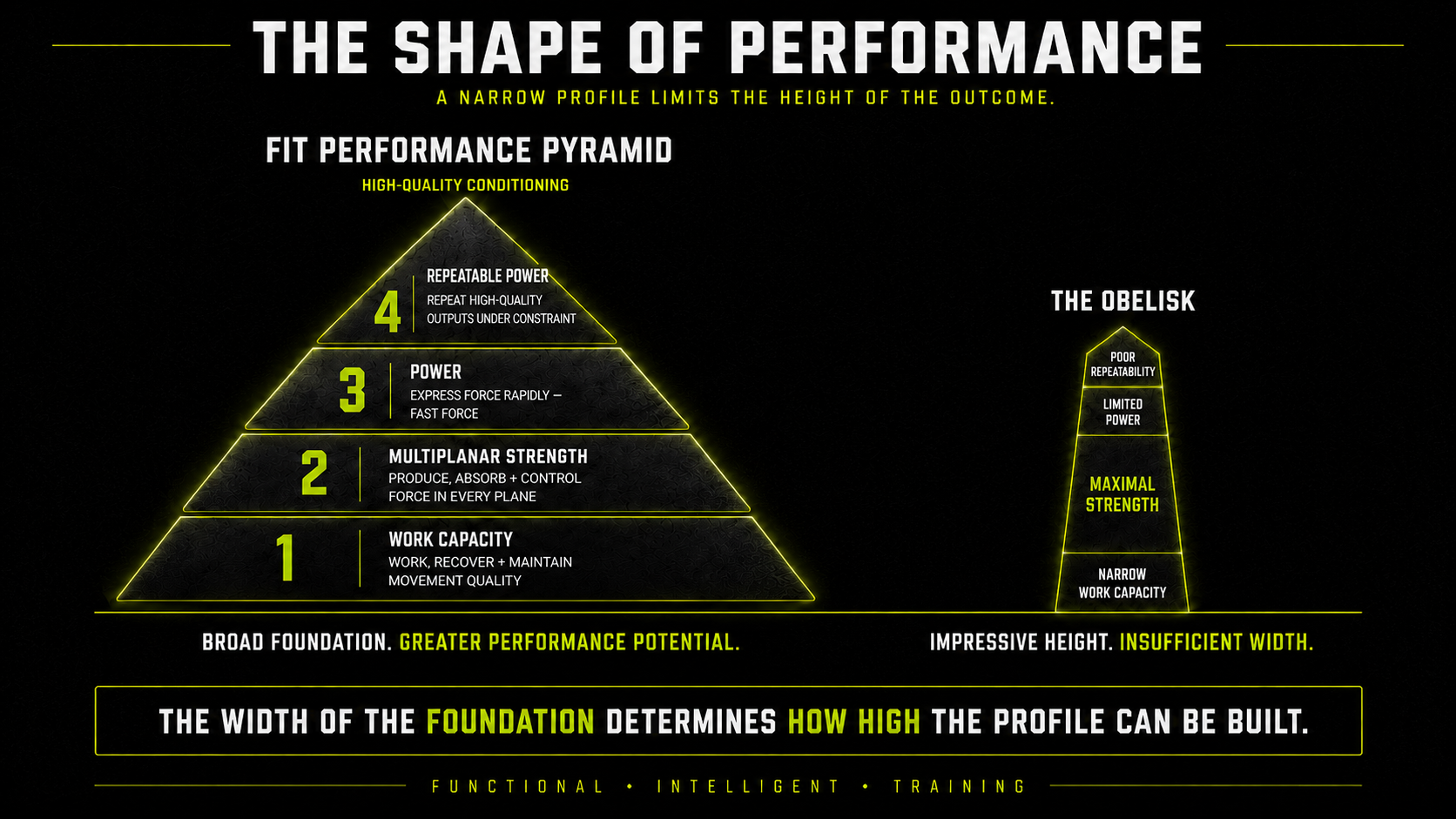
The FIT Performance Pyramid for Adults
FIT organizes physical development through four connected levels.
1. Work Capacity
The ability to perform productive work, recover between efforts, and maintain movement quality as the session continues.
2. Multiplanar Strength
The ability to produce, absorb, and control force across different stances, directions, and planes of movement.
3. Power
The ability to express force rapidly—and to accept force safely when landing, decelerating, or changing direction.
4. Repeatable Power
The ability to reproduce high-quality output when time and recovery are limited.
Work capacity supports strength. Strength raises the potential for power. Power becomes more useful when it can be repeated.
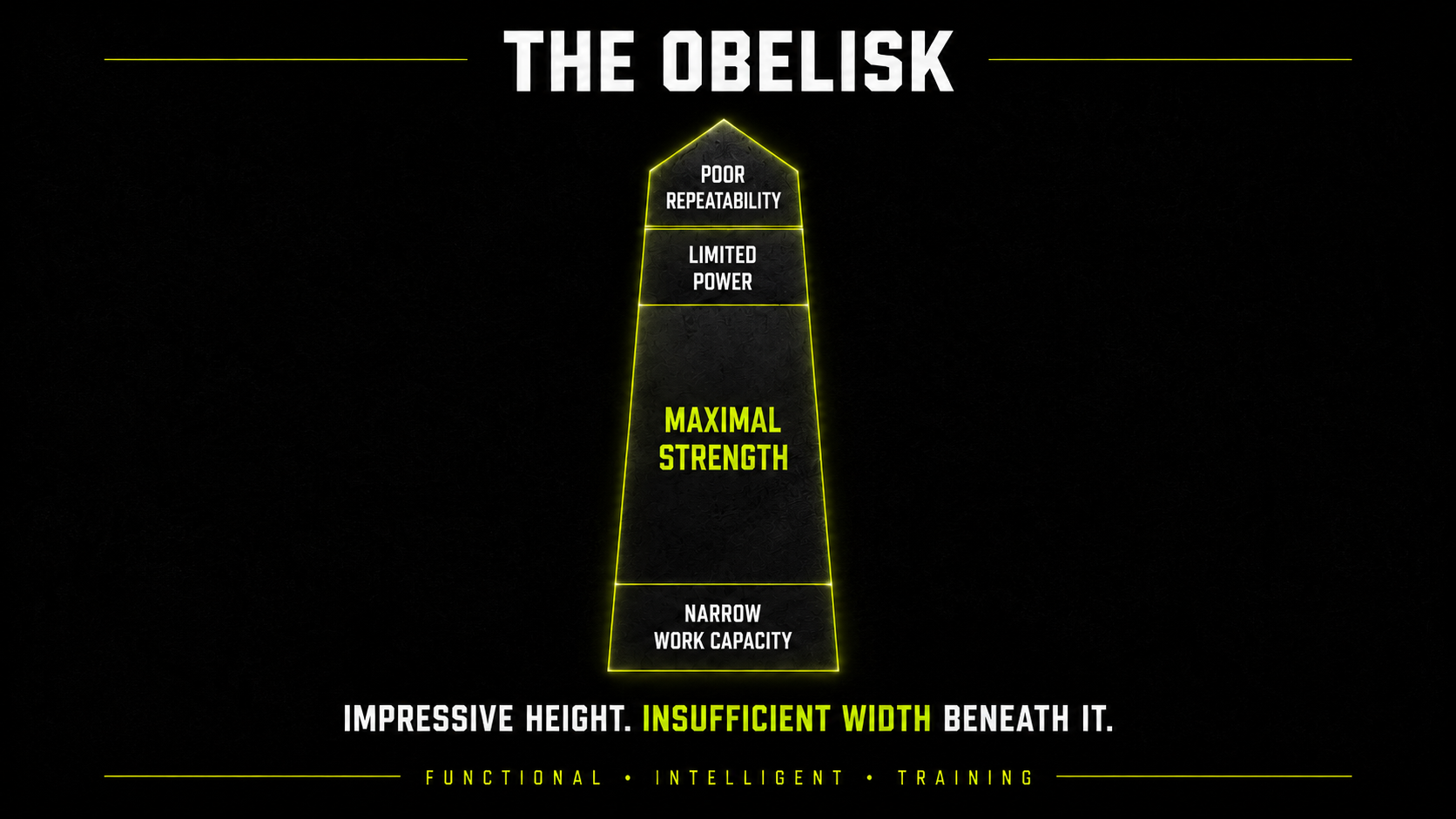
The Obelisk Problem
Some adults build an impressive peak on top of a narrow base.
A person may possess excellent maximal strength but lose meaningful output as soon as repeated efforts and incomplete recovery enter the session. They can express strength only in conditions they control: familiar exercise, full rest, preferred setup.
Their profile resembles an obelisk—impressive height with insufficient width beneath it.
Total Fitness builds a broader pyramid so strength and power remain available when the environment stops accommodating the person’s preferences.
Learn more about the complete system in the FIT Methodology.
How Total Fitness Develops Complete Adult Athleticism
Total Fitness uses a predictable weekly structure. Every day has a clear emphasis, and every session belongs to a larger plan.
Monday: Sagittal and Bilateral Strength and Power
Monday generally permits the highest absolute loading of the week. Adults develop foundational force through bilateral and sagittal-dominant patterns while performing appropriately selected power and force-absorption exercises.
Tuesday: Repeatable High Output
Tuesday uses shorter work-to-rest intervals, explosive movements, and meaningful strength exercises arranged to create both a muscular and conditioning effect.
A common format is 15 seconds of work followed by 15 seconds of rest for six intervals at one station before rotating. Exercises may include staggered-stance or single-leg hinges, lunges, kettlebell or dumbbell movements, and other valuable strength exercises that do not occupy the primary strength menu.
This day teaches adults to reproduce output after incomplete recovery. It also exposes whether a strong client possesses enough general work capacity to use that strength beyond a fully rested set.
Wednesday: Frontal-Plane Strength and Power
Wednesday emphasizes lateral movement, frontal-plane strength, unilateral and asymmetrical positions, and the ability to resist unwanted lateral motion.
Thursday: Sustained Capacity
Thursday uses longer work periods—such as 90 seconds of work followed by 30 seconds of rest—and exercises suited to sustained output.
Loaded carries, AirBike intervals, rowing, SkiErg work, running, and controlled kettlebell sequences can develop aerobic power, muscular endurance, pacing, and the ability to continue producing useful work as fatigue accumulates.
Exercise complexity generally decreases as interval duration increases. The goal is to challenge the energy system without allowing fatigue to turn technical exercises into poor ones.
Friday: Rotational and Transverse-Plane Strength and Power
Friday emphasizes rotation, transverse-plane force, trunk control, and the transfer of force between the hips and upper body. Absolute loading is generally lower than Monday while coordination and multiplanar demands increase.
Saturday: Expand or Restore
Saturday provides a flexible conditioning format for useful work-to-rest structures that do not fit cleanly into Tuesday or Thursday. Countdown workouts, four-minute work blocks, mixed-modal circuits, and lower-intensity aerobic sessions may appear here.
For someone who trained hard throughout the week, Saturday can be scaled toward lower-cost aerobic work and recovery. For someone who missed another conditioning day, it can function as a meaningful training session.
The format creates the opportunity. The individual prescription determines the cost.
How Often Should Adults Train?
Strength and power are the main course. Conditioning is layered onto that foundation.
Three days: Monday, Wednesday, and Friday strength and power
Four days: Three strength-and-power sessions plus one conditioning day
Five days: Three strength-and-power sessions plus two conditioning days
Saturday: Optional supplemental or recovery-oriented work according to the individual week
Two well-coached sessions can still create progress when life constrains attendance. The most complete weekly exposure occurs through the three strength-and-power days with conditioning added according to goals and recoverability. View the current Total Fitness schedule or explore the Total Fitness program.
Scaling Is More Than Using a Lighter Weight
FIT uses progression, regression, and lateralization to preserve the intended adaptation while changing the route.
Consider a frontal-plane strength day.
Jamie may perform a deep side squat while holding a 100-pound dumbbell in a goblet position. If his mother cannot perform that side squat to the required standard, simply giving her a very light version may not be the best solution.
She can perform a bilateral squat while holding one dumbbell on one side. The movement becomes more familiar, but the offset load still requires her to resist lateral flexion and supports the day’s frontal-plane emphasis.
The exercise changed. The intended quality remained.
Power training follows the same principle. One capable client may perform a rotational box jump into a rotational depth drop. Another may step onto the box before performing an appropriately selected rotational, lateral, or standard depth drop. If stepping from the box is not appropriate, the coach selects a lower-level landing or force-absorption exercise.
The coach can adjust:
Load
Load placement
Range of motion
Base of support
Stance
Plane of movement
Speed
Impact
Stability demand
Technical complexity
Lateralization is not random modification. It is the ability to preserve the day’s objective without forcing every person through the identical exercise.
Same system. Individual prescription.
The Warm-Up Is a Live Assessment
New clients are always loaded conservatively. Movement ownership comes before greater load, speed, or complexity.
The warm-up frequently includes lower-demand versions of patterns that will later be loaded more heavily or performed at greater speed. This gives the coach immediate information about posture, position, coordination, range of motion, and readiness before the primary work begins.
New clients progress through three layers:
1. Recognition
They understand the exercise name, the day’s movement emphasis, and what the task requires.
2. Ownership
They can perform the movement correctly without repeated coaching.
3. Intensity
Once the movement is understood, owned, and no longer sufficiently challenging, the coach increases the appropriate demand through load, speed, range, output, or complexity.
Learning exercise nomenclature is an undervalued assessment. A client who hears the name of a task, organizes the body, and performs it correctly is demonstrating growing physical literacy and autonomy.
Clients who require continuous one-on-one correction, prefer private training, possess significant limitations, or need hours outside the group schedule may be better served through Personal Training.
Safety Without Softness
FIT considers the contextual orthopedic cost of every exercise.
Orthopedic cost is not a label permanently attached to a movement. It depends on the person, the dose, the speed, the range, the loading, the fatigue state, and where the exercise appears in the training week.
A box jump can be an appropriate power exercise while a client is fresh and receiving coaching. It becomes a poor conditioning choice when fatigue, repetition, and urgency degrade takeoff and landing quality.
FIT manages training cost by:
Protecting quality during high-speed and high-impact work
Using lower-complexity exercises during longer conditioning intervals
Choosing nonimpact modalities when the energy system can be trained without additional pounding
Considering the previous and following training days
Adjusting load, stance, range, and exercise selection in real time
Ending or changing a task when discomfort or deteriorating movement requires it
When discomfort appears, FIT coaches may adjust loading, range of motion, stance, exercise selection, and relevant muscular demands within the scope of fitness coaching. Persistent pain, acute injury, neurological symptoms, significant swelling, instability, or concerns outside that scope require evaluation by an appropriate healthcare professional.
The goal is not to make training easy. It is to make hard training productive and repeatable.
Not easy. Not soft. Just smarter.
Coaching, Not Merely Instruction
Instruction explains the workout. Coaching observes the person and determines what should happen next.
During a Total Fitness session, the coach continuously moves through the training floor. More attention is directed toward newer clients and exercises carrying greater technical or orthopedic consequence, but every client remains part of the coaching environment.
A FIT coach:
Watches repetitions rather than merely managing the clock
Corrects posture, position, range, tempo, and intent
Adjusts loads when the prescribed stimulus is being missed
Selects lateralizations when an exercise does not fit the person
Distinguishes useful fatigue from deteriorating execution
Allows experienced clients appropriate autonomy without ignoring them
Has at least one meaningful personal interaction with every client before they leave
Clients should feel individually recognized inside the group.
The system is led by Jamie Dixon, a former collegiate All-American and All-Decade football player, former collegiate strength-and-conditioning coach, and coach with a master’s degree in kinesiology, CSCS certification, NSPA Master Sports Performance Coach distinction, and extensive education in strength, power, speed, agility, and program design.
Expert programming determines what belongs in the session. Expert coaching determines how that session should meet the person standing in front of the coach.
FIT Pro Day: Testing Complete Athleticism
Adults tend to train the qualities they already enjoy.
Strong people often choose strength days because those sessions confirm an identity they already possess. Conditioning feels harder, so it is easier to avoid. Other adults may enjoy aerobic work while continually avoiding the strength and power training that exposes their limitations.
FIT Pro Day is designed to make those gaps visible.
The adult testing framework includes:
Vertical jump
Broad jump
Pro-agility 5-10-5
One-mile run
Bench-press one-repetition maximum
Strict chin-ups, with weighted chin-ups incorporated at higher levels
Together, the battery samples:
Absolute strength
Relative strength
Vertical and horizontal power
Acceleration, deceleration, and change of direction
Conditioning and work capacity
The purpose is not to reward the qualities a client prefers to train. It is to determine whether the total training profile reflects complete athleticism.
A high strength score does not erase poor conditioning. A good mile does not erase inadequate force production. Impressive gym numbers do not automatically demonstrate power, agility, or movement skill.
If FIT only cared about strength, we would test strength lifts. If FIT only cared about power, we would test jumps. The battery includes strength, relative strength, power, agility, and conditioning because no single quality is allowed to define the entire person.
FIT Pro Day is being introduced as the objective measurement system for Total Fitness. As participation and repeat testing create a larger body of data, FIT will use those results to document individual progress, expose attendance-driven gaps, and study how complete adult athleticism changes over time.
What This Looks Like in Real Adults
Total Fitness serves adults with different histories and different starting points.
Transformation While Becoming More Capable
Jennifer began Total Fitness in November. While using a GLP-1 medication, she has lost 60 pounds and dramatically improved her strength and power. Her experience demonstrates that substantial weight loss and physical development can occur together when training remains part of the process.
Preserving the Former Athlete
One 38-year-old former college football player has participated in Total Fitness for six years and regularly says that he still has “a few good games left in him.”
He is not preparing to compete again. He is preserving enough strength, power, conditioning, and physical confidence that the athlete he once was has not completely disappeared.
Building Capability for the Long Term
Jamie’s parents were his first clients. Both are now 66 and remain exceptionally strong, powerful, and physically capable. Their training demonstrates what Total Fitness ultimately wants to produce: older adults with an unusually large reserve of physical freedom.
FIT Handles the System. The Client Supplies Participation.
FIT removes nearly every technical and logistical barrier inside the training hour.
We provide:
The warm-up
The program
The equipment
The exercise instruction
The coaching
The progressions, regressions, and lateralizations
The daily structure
The long-term plan
The client remains responsible for:
Showing up consistently
Applying honest effort
Remaining coachable
Communicating legitimate limitations
Accepting that beneficial work will not always be enjoyable
Aligning behavior with the outcome they claim to want
People naturally gravitate toward tasks that confirm their competence and avoid tasks that expose them. Sometimes an exercise is inappropriate for the person. Sometimes it is difficult because it reveals an underdeveloped quality.
Good coaching distinguishes between the two.
FIT can remove confusion, provide structure, and coach the work. The client must participate in the process. A coach cannot care more about the outcome than the person pursuing it.
Where Nutrition Fits
Total Fitness can provide practical nutritional guidance, but the greater value lies in coaching sustainable behavior.
Most adults already understand the broad principles: consume sufficient protein, manage total intake, hydrate, and choose mostly high-quality foods. Consistently executing those behaviors amid work, family, travel, stress, and social life is the harder problem.
Training can improve strength, power, conditioning, movement quality, and physical confidence even when body weight does not change. Significant fat loss and visible body-composition change require nutrition to support that outcome.
Total Fitness does not promise a meal plan or an identical aesthetic result for every person. Genetics, nutrition, hormones, age, training history, attendance, and recovery all influence appearance.
Who Total Fitness Is Not Designed For
Total Fitness develops broad adult athletic capability. It is not designed to maximize every specialized pursuit.
The program is not the correct primary system for:
Competitive bodybuilders
Competitive powerlifters
Competitive CrossFit athletes
Olympic-weightlifting specialists
Someone requiring medical diagnosis or rehabilitation
Someone seeking unsupervised gym access
Someone unwilling to attend consistently or receive coaching
Specialized competition requires specialized practice. Medical rehabilitation requires an appropriately licensed healthcare professional. Open-gym access requires a different business model.
FIT stays focused on its main objective: helping adults look, move, and feel athletic for life.
What Results Should an Adult Expect?
With consistent training, an adult should expect to become:
Stronger in multiple planes and positions
More powerful
Better conditioned
More physically literate
More confident in unfamiliar physical environments
Less dependent upon constant coaching
Better able to produce, absorb, and repeat force
Within approximately five months, the intended result is an adult who visibly and physically looks, moves, and feels more athletic.
When nutrition supports fat loss or muscle gain, clothing may fit differently and body composition may change substantially. Training alone cannot guarantee a specific appearance, amount of weight loss, or athletic result.
FIT can promise a coherent system, expert coaching, measurable targets, and a process designed to develop complete adult capability.
Train Today for the Freedom You Want to Keep Tomorrow
The purpose of adult training is larger than surviving a workout or improving one gym number.
It is building a body that remains useful, adaptable, and trustworthy as the years pass.
Total Fitness gives adults the structure, coaching, and complete physical exposure required to develop that body. Your responsibility is to begin.
What Happens Next
Complete the Get Started form and tell us about your goals, schedule, and training background.
Jamie will personally contact you as quickly as possible—typically well inside 24 hours, with weekends occasionally requiring longer.
Begin with a paid one-week trial. There is no three-month commitment during the trial.
If Total Fitness is the right fit, continue through the standard three-month membership commitment.
During your first paid membership week, you may bring a friend to make the transition into the group more comfortable.


Frequently Asked Questions
Still have questions? Take a look at the FAQ or reach out anytime. If you’re feeling ready, go ahead and apply.
-
Adult athleticism is the ability to express strength, power, coordination, movement skill, and work capacity across different tasks and directions. It allows adults to remain capable in training, recreation, family life, work, and unfamiliar physical situations.
-
No. New clients are loaded conservatively and coached according to their current ability. The warm-up helps the coach assess movement before similar patterns are loaded more heavily or performed at greater speed.
-
No. Former athletes can preserve and rebuild qualities they once possessed, while adults without an athletic background can develop those qualities for the first time. The system is shared, but exercise selection and loading are individualized.
-
Yes, when the person is appropriate for group training. Chronological age does not make the final exercise decision; demonstrated capability does. Load, range, speed, impact, stance, and complexity can all be adjusted.
-
They can when appropriate. Power training may include box jumps, step-ups into depth drops, lower-level landing drills, medicine-ball throws, kettlebells, and other scalable exercises. Producing force and absorbing force can both be trained without forcing every adult to perform the same task.
-
No. CrossFit competitors train for a specific competitive ecosystem that includes Olympic lifts, gymnastics, standardized movements, and mixed-modal events. Total Fitness is organized around broad adult athleticism, multiplanar strength and power, conditioning, physical literacy, and long-term capability.
-
Substantial muscular size does not appear accidentally. Total Fitness combines balanced strength, power, conditioning, and multiplanar movement rather than bodybuilding specialization. Genetics, nutrition, hormones, and total training volume strongly influence appearance.
-
Coaches can often adjust load, stance, range of motion, exercise selection, and stability demands while preserving the intended training effect. Persistent pain, acute injury, neurological symptoms, instability, or concerns outside the scope of fitness coaching require evaluation by an appropriate healthcare professional.
-
FIT prioritizes three weekly strength-and-power sessions. One or two conditioning days can then be added according to goals, schedule, and recovery. Adults training fewer days can still progress, although they receive less complete exposure to the weekly system.
-
FIT uses strength progression, work-capacity benchmarks, movement quality, coaching observation, and the FIT Pro Day testing framework. FIT Pro Day samples vertical and horizontal power, agility, absolute and relative strength, and conditioning rather than allowing one lift to define fitness.
-
Adults requiring continuous one-on-one correction, a private environment, hours outside the class schedule, or more individualized management may begin with Personal Training. Complete the Get Started form and FIT will help identify the appropriate entry point.
-
Complete the Get Started form. Jamie will contact you personally and help schedule a paid one-week trial with no continuing obligation. If the program is the right fit, the standard membership begins with a three-month commitment.